




AI is becoming part of everyday business operations. And, for many organizations, the next challenge is making sure governance can keep up.
But let’s see what the data tells us.
First, McKinsey found that governance and risk management are still struggling to keep pace with increasingly autonomous AI. On the other hand, Gartner expects governance failures to lead 40% of enterprises to demote or decommission autonomous agents by 2027.
To put an example, the gap is even clearer in financial services, where a recent study found that 88% of professionals lack a governance framework for agentic AI. At the same time, paradoxically, although global IT spending is expected to reach $6.37 trillion this year, companies are still struggling to prove ROI.
Taken together, these signals point to a practical need: more visibility into how AI operates across their business processes, what it consumes, and what outcomes it produces. This is where SAP Signavio becomes relevant.
What is SAP Signavio?
Now, SAP Signavio is SAP’s cloud platform for business process transformation and process intelligence. It basically gives organizations a shared view of how processes work today, how they should work, and where they can be improved.
However, it’s Process Transformation Suite brings together several capabilities, including:
- Process Modeler provides the process blueprint, allowing teams to model workflows, define activities and responsibilities, document variations, and simulate changes.
- Process Intelligence compares that blueprint with real execution data to identify process variants, bottlenecks, deviations, rework, and compliance issues across SAP and non-SAP systems.
- Process Governance adds ownership, standards, approvals, and controls around how processes are designed and changed.
- Process Transformation Manager connects process findings with transformation initiatives, priorities, and measurable objectives.
- AI Agent Mining extends these capabilities into AI-enabled processes, using AI to analyze process data and, increasingly, examine how AI agents execute within those processes.
Let’s use an example to make this more tangible.
Consider a typical Order-to-Cash process. It may run through SAP S/4HANA, involve 12 departments and three additional systems, generate 20 process variants, and include multiple exceptions and human interventions.
In a first approach, SAP Signavio can reconstruct those variations from execution data and show where the process deviates from its intended design. But what happens if we introduce an AI agent for invoice validation or exception handling? In this case, AI Agent Mining extends process intelligence to the agent itself.
This way, by bringing AI agent execution data into Signavio, organizations can:
- Analyze how agents interact with the process.
- From the expected process (skipping a step, taking an unexpected path, requiring human intervention, etc.).
- How often is human intervention required.
- How their execution affects process performance.
In short, this is where SAP Signavio becomes relevant to AI governance. It provides a process-level view of AI, connecting agent behavior with the business processes, controls, and outcomes around it.
Closing the Loop: From SAP Signavio to Agent Governance & AI FinOps
Now, as we already know, as AI becomes embedded in business processes, governance needs to account for more than the AI systems themselves. The business process provides the context needed to understand where AI creates value, where it introduces friction, and where its consumption generates value for the organization.
This creates an interesting intersection between process intelligence, AI agent governance, and AI FinOps. SAP Signavio sits at the process layer, where AI activity can be connected to the operational work it supports.
The implications are worth looking at from two complementary angles.
First, how process intelligence can strengthen agent governance by providing visibility into AI behavior within business processes. Second, how process context can add meaning to AI consumption data, connecting token usage and AI costs with the processes and outcomes behind them.
But let’s look at each of these connections in more detail.
From agent governance to process governance
Agent governance typically focuses on the AI asset itself. Organizations need to know which agents exist, who owns them, what they can access, and what actions they are allowed to perform.
Process context adds another dimension. Just consider an AI agent handling invoice exceptions. Its permissions may be properly configured, but that alone does not tell the organization whether the agent is handling exceptions as intended.
SAP Signavio can provide visibility into the process surrounding that agent. Organizations can examine where the agent operates, which process steps it affects, how execution varies across cases, and where human intervention occurs.
This makes it possible to identify situations such as:
- An agent repeatedly triggering additional approval steps.
- An agent taking a process path that differs from the expected design.
- Certain invoice types require significantly more human intervention.
- A process variant generating unusually high levels of agent activity.
- AI-assisted steps creating delays elsewhere in the workflow.
The governance question therefore gains operational context. Instead of looking only at whether an agent is authorized to act, organizations can examine how that agent behaves within the process it supports.
Connecting Tokenomics to Process Context
The same process context also matters when looking at AI consumption.
Token usage is generated by specific business activities. The amount consumed can vary significantly depending on the process path, the type of case being handled, and the number of AI interactions required to complete the work.
AI FinOps can measure the economic side of this chain, including consumption, costs, budgets, and anomalies. Process intelligence adds another layer by showing what was happening in the business process when that consumption occurred.
That distinction becomes increasingly important at scale. A token-level dashboard may show that one process path costs significantly more than another. Process data can help explain why (inefficient process variant, repeated exceptions, unnecessary handoffs, etc.).
This creates a broader set of optimization options:
- Optimize the process: Reduce unnecessary steps, rework, or avoidable exceptions.
- Optimize the agent: Improve its instructions, tools, or execution logic.
- Optimize model usage: Match model capabilities and costs to specific process activities.
- Optimize human involvement: Identify where human intervention is necessary and where it adds the most value.
- Optimize AI consumption: Set appropriate limits and controls for workloads with predictable usage patterns.
In short, AI FinOps provides visibility into the economics of AI consumption. Process intelligence provides the operational context needed to understand what is driving that consumption and where optimization efforts may have the greatest impact.
Building an AI Governance Architecture: SAP Signavio, LeanIX, and AI Agent Hub
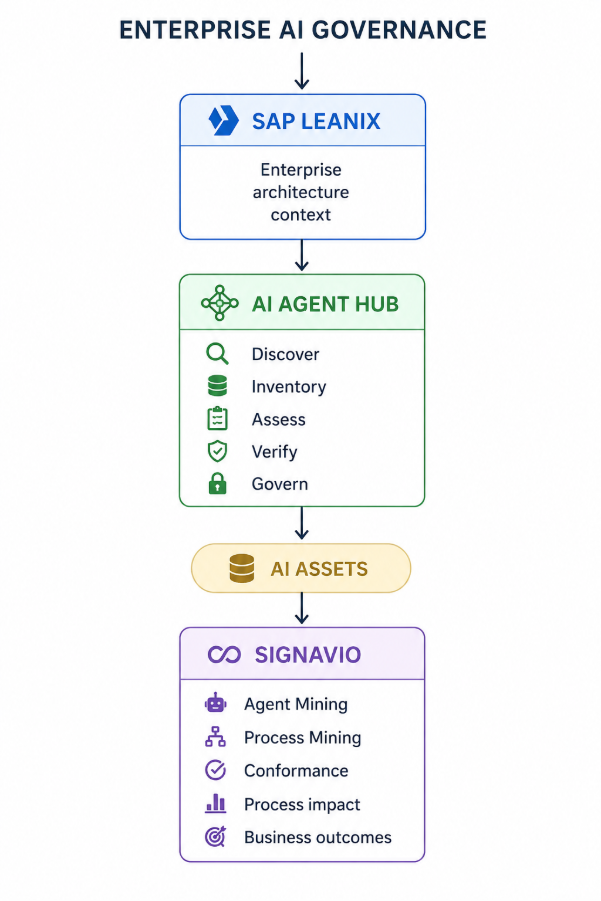
Now, SAP Signavio, SAP LeanIX, and SAP AI Agent Hub are separate capabilities within the SAP ecosystem, each addressing a different aspect of enterprise AI management. Looking at them together, however, provides a more complete picture of how AI fits into the organization.
In the sections below, we will look at what each capability brings to the table and how their different perspectives can work together across enterprise architecture, AI asset governance, and business process execution.
SAP LeanIX: Where Does AI Fit?
SAP LeanIX provides the enterprise architecture context. Its Enterprise Architecture Management capabilities map applications, technologies, business capabilities, organizations, dependencies, and lifecycle information.
On the other and, SAP is extending this architectural view to include AI technologies and their relationships with the wider enterprise landscape. This way, LeanIX can be useful to gain visibility on where AI exists in the enterprise and what is it connected to.
For example, a customer service team may use an AI agent within its service platform to classify requests and retrieve information from SAP systems through an MCP server.
LeanIX can map the connection between the business capability, the application, the AI agent, the underlying LLM, and the systems it depends on. This architectural context can help organizations understand how an AI capability relates to applications, business functions, and technology dependencies.
AI Agent Hub: What AI Assets Are We Governing?
AI Agent Hub adds a more specific AI asset governance layer. As SAP is expanding it as a broader capability within the Business AI Platform, its role extends to discovering and governing AI agents, models, and MCP servers across the enterprise.
The lifecycle can be understood as the following:
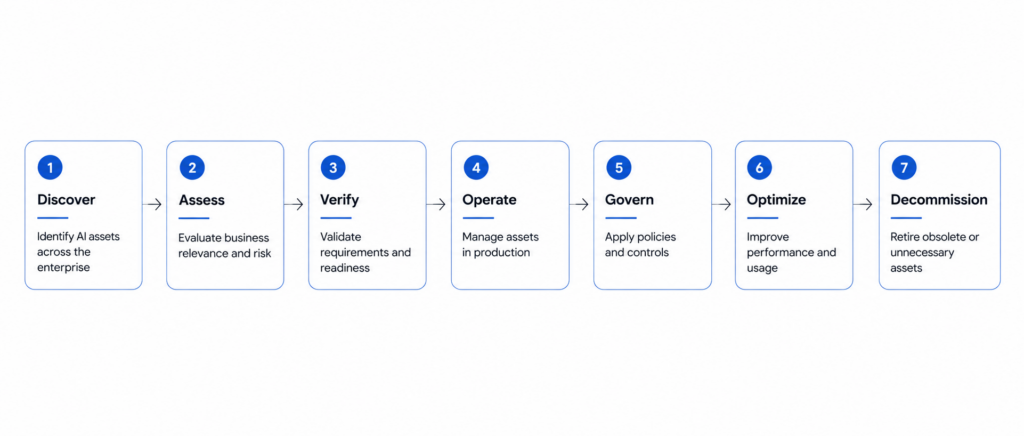
This way, it basically provides a structured way to manage AI assets throughout their lifecycle.
Let’s came back to our customer service team. While LeanIX provides the architectural context around AI, SAP AI Agent Hub focuses on the AI assets within that architecture, helping teams to:
- Discover: Identify AI agents and other AI assets across the enterprise.
- Assess: Evaluate their relevance, requirements, and potential risks.
- Verify: Confirm their status and readiness for use.
- Govern: Apply controls throughout the AI asset lifecycle.
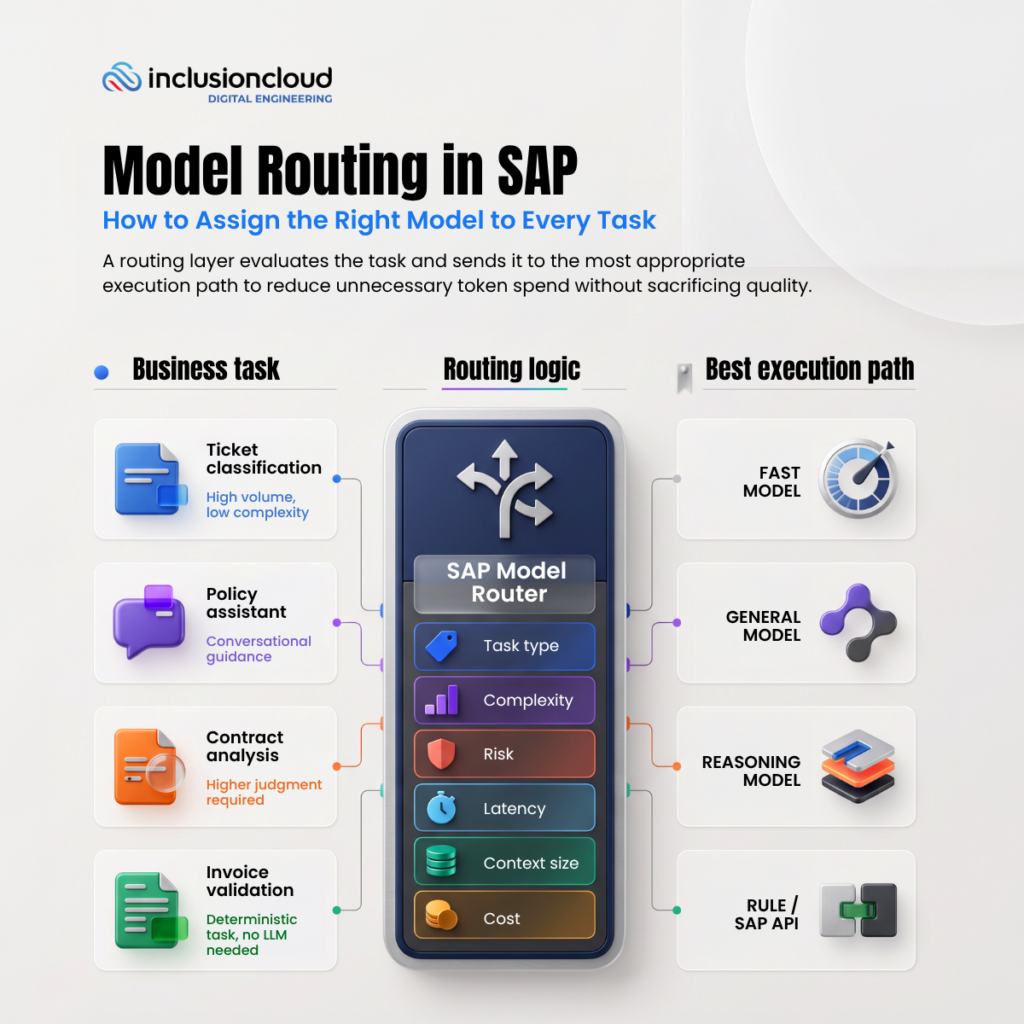
That distinction also creates an interesting connection with model routing. A routing strategy needs reliable information about the models available to the organization, including their providers, versions, approval status, and intended use.
AI Agent Hub can contribute to this governance context by providing visibility into the AI assets that agents depend on. However, it does not make routing decisions at runtime.
Its role is to help organizations understand and govern the AI estate, providing inventory and lifecycle information that can support model management and routing policies. In short, model routing determines which model should handle a task. SAP AI Agent Hub establishes the governance context around AI assets available to perform that work.
SAP Signavio: How Is AI Actually Operating?
Now, the final layer is the business process itself.
Once an organization knows where AI fits architecturally and which AI assets are deployed, another question becomes increasingly important: How is that AI actually behaving within the work it supports?
This is where SAP Signavio adds a different type of visibility.
Through the AI Agent Mining connector, agent activity data can be brought into SAP Signavio Process Intelligence as analyzable event data. That makes it possible to examine agent execution alongside the business process.
Now consider the same customer service agent once it starts handling requests. SAP Signavio adds the process context by analyzing how the agent’s activity affects the underlying customer service workflow. In this case, it can show:
- Whether the agent follows the expected process.
- Where requests deviate from the standard path.
- When human intervention is required.
- How those variations affect process outcomes.
In short, this creates a process-level view of AI activity. So, instead of stopping at the fact that an agent exists or is active, organizations can examine how its execution relates to process paths, deviations, interventions, and outcomes.
The Bigger Picture
As AI becomes more deeply embedded in business processes, governance needs to connect different layers of the enterprise.
SAP LeanIX provides the architectural context. It helps organizations understand where AI sits within their applications, technologies, business capabilities, and dependencies.
SAP AI Agent Hub adds the AI asset governance layer. It helps organizations discover, assess, verify, and govern agents, models, and related AI assets throughout their lifecycle.
SAP Signavio adds the process layer. Through process intelligence and AI Agent Mining, it helps organizations understand how AI activity affects process execution, deviations, interventions, and business outcomes.
Together, these layers provide different perspectives on the same AI operating environment:
- Where AI fits.
- What AI assets are being governed.
- How AI performs within business processes.
This architecture also creates a more complete foundation for managing AI economics. AI FinOps can measure consumption and cost, while process intelligence can provide the context needed to understand what is driving that consumption and where optimization may have the greatest business impact.
The goal is ultimately broader than monitoring AI assets. It is about connecting AI governance, process performance, and business value as AI becomes part of everyday operations.
If your landscape is moving in this direction, at Inclusion Cloud we can help. As official SAP partners, we can design and implement the governance, integration, and process intelligence capabilities needed to scale AI responsibly.
Our certified consultants support development, integrations, migrations, deployment, and ongoing optimization across SAP environments, including regulated industries and public services, where traceability, access controls, compliance, and cost visibility become increasingly important.
Book a call with our team to review your SAP AI landscape and identify where stronger AI business cases could create the most value.