




Every few months, the software industry announces its own death.
SaaS is collapsing.
Apps are becoming obsolete.
AI agents will replace entire platforms.
The argument often sounds like a loose version of evolutionary theory. Certain forms of software quietly disappear while new ones emerge. Some tools adapt to changing conditions. Others don’t. And every so often, a new software “species” shows up and steals the spotlight.
With some types of SaaS, this logic may hold. Tools that exist only to build dashboards, generate simple reports, or solve a very narrow problem can increasingly be replaced by AI-built applications that do the same job (and often more) without the overhead of a dedicated product.
But when software supports core business processes, and when failure has a direct financial impact, the story changes completely.
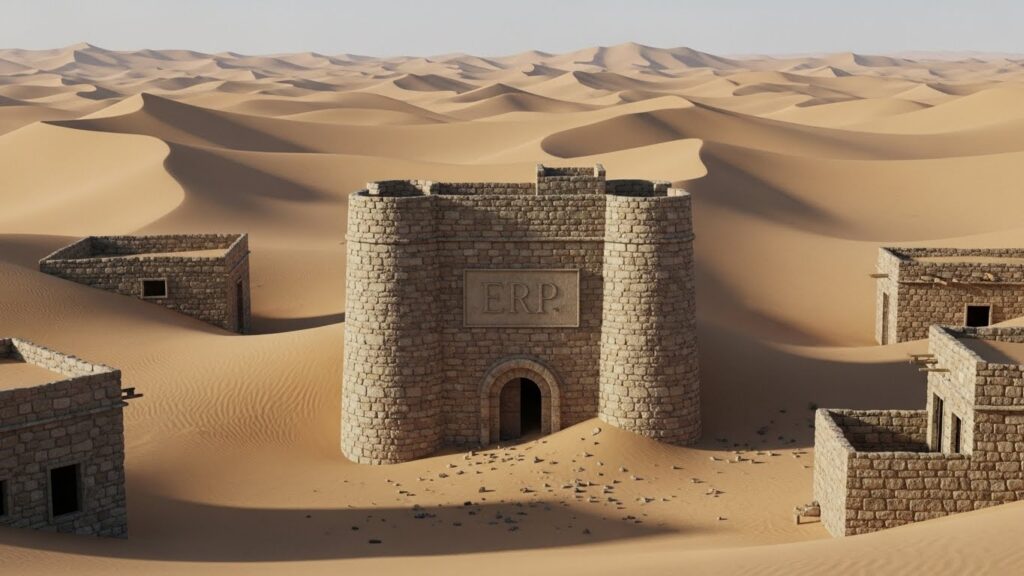
ERP is the clearest example of that.
When “AI Will Replace SaaS” Sounds Plausible
The argument that AI could replace SaaS is not irrational.
In a recent article, “Is AI Going to Take Down SaaS Companies? ServiceNow Isn’t Worried,” we laid out this debate clearly. On one side, Satya Nadella suggests that in the agentic AI era, “the very notion that business applications exist” could eventually collapse. His reasoning is blunt: most business apps are still CRUD systems with rules. If that logic moves into a shared AI layer operating across systems, apps could be reduced to execution surfaces.
On the other side, ServiceNow CEO Bill McDermott is far less concerned. His argument is that customers cannot easily recreate what took decades to build: deeply embedded workflows, governance, security, compliance, and operational knowledge accumulated across thousands of real-world enterprises.
Both perspectives can be true at the same time.
AI is lowering the cost of building software.
AI is changing the build-versus-buy equation.
AI will replace certain categories of applications.
But none of that automatically applies to ERP.
ERP Is Not in Survival Mode. It Is Still Growing.
What makes this more interesting is the broader context in which all of this is happening.
We are not living in a period of stability. Quite the opposite. Economic uncertainty has become a defining feature of the global economy. At a recent World Economic Forum gathering, one economist put it bluntly: “Uncertainty has become its own economic actor.” Surveys of chief economists show overwhelming agreement that uncertainty is unusually high, with direct consequences for investment decisions, long-term planning, and risk appetite.
Technology is not immune to this uncertainty. In fact, AI has added a new layer to it. While AI opens up new possibilities, it also creates hesitation. CIOs are unsure which tools will still matter in three years. Which platforms will be replaced. Which investments will age well, and which won’t.
And yet, in the middle of all this uncertainty, ERP market is not shrinking.
According to Grand View Research, the global ERP software market was valued at USD 64.83 billion in 2024 and is projected to reach USD 123.41 billion by 2030, growing at a compound annual growth rate of 11.7% between 2025 and 2030.
That is not a category in survival mode.
That is not a market bracing for extinction.
That is a market accelerating.
The reasons behind that growth are revealing. Demand is being driven by the need for data-driven decision-making and increasingly complex, regulated operations. In other words, as the world becomes more volatile, companies are doubling down on the systems that give them control, visibility, and financial certainty.
In uncertain times, businesses don’t gamble with their core.
ERP is not treated like a disposable app. It is treated like the engine of the organization. You might modernize the engine. You might move it to a new platform. You might tune it, optimize it, or make it more efficient. But you don’t rip it out and experiment with replacements while the company is still moving.
ERP Is Not “Just Another SaaS Category”
ERP touches the most unforgiving parts of a business:
- how money is recognized
- how inventory is valued
- how payroll is executed
- how compliance is enforced
- how financial reality is reported
To put it in a few words: If an ERP fails, the company stops operating.
That alone puts ERP in a different class from most SaaS products being discussed in AI replacement debates.
And the market data confirm it: ERP is a massive, competitive, strategic category where established players continue to lead and expand.
According to multiple industry estimates, Oracle surpassed SAP in 2024 to become the largest ERP applications vendor, with roughly USD 8.7 billion in ERP revenue and about a 6.6% share of the global ERP market, while SAP followed closely with USD 8.6 billion and a similar market share. There is little doubt that Oracle and SAP remain the undisputed leaders in this segment, each with decades of experience and market presence.
Why Modernizing ERP Is Necessary, and Why It Rarely Goes as Planned
ERP modernization is not optional forever. But it is also not something companies can rush without consequences.
On one side, vendors are clearly pushing the market forward. SAP customers face a hard deadline with ECC support ending in 2027. Oracle customers operate under a different model, with long-term and rolling support that extends well into the 2030s. Different pressure models, same direction of travel.
In practice, ERP modernization exposes everything that accumulated quietly over decades: undocumented processes, fragile integrations, custom logic built to solve edge cases, and historical data that no one fully trusts but everyone depends on.
That is why timelines that look reasonable on paper tend to stretch. On forums like Reddit, it is common to see teams describe projects initially scoped for six months extending to sixteen, or even becoming multi-year efforts. The pattern is consistent: the technology itself is rarely the main blocker. The real complexity lives in the business logic encoded inside the system.
And going live is not the finish line. It is the moment when the system finally meets the full weight of day-to-day operations: finance closing cycles, production planning, payroll, compliance checks, and downstream reporting. Any gap shows up immediately.
This is also why ERP modernization carries a level of business risk that most SaaS upgrades simply do not. A failed dashboard is annoying. A broken CRM slows revenue. A misaligned ERP disrupts how money, inventory, and obligations move through the organization.
None of this means ERP is frozen in time.
For most organizations, the real question is not “Can we modernize ERP?”
It is “How do we modernize without destabilizing the business we already rely on?”
And that question is precisely why ERP continues to sit outside the simplistic narrative that “AI will replace SaaS.”
Conclusion:
If parts of the SaaS market are slowly eroding, ERP is moving in the opposite direction.
Not because enterprises are nostalgic, or resistant to change, but because ERP sits at the center of many key business processes. Revenue recognition. Inventory valuation. Payroll. Compliance. Financial reporting. These are not areas where companies experiment, especially in times of uncertainty.
And uncertainty is no longer a temporary condition. Economic volatility, geopolitical tension, regulatory pressure, and fragile supply chains have turned unpredictability into a permanent feature of the global economy. In that context, companies do not look to replace the systems that keep the lights on.
That is why ERP is not shrinking. It is growing.
Oracle and SAP continue to lead not because they are trendy, but because their platforms underpin how large organizations operate, report, and survive. Modernization is happening, but it happens carefully, on business timelines, and with risk management at the center of every decision.
At Inclusion Cloud, we work with ERP for what it really is: a system you cannot afford to break.
As certified partners of SAP and Oracle, we help organizations modernize and configure their ERP environments while protecting the core processes that keep the business running. From cloud migrations to system optimization and post-go-live stabilization, our teams focus on one thing above all else: making change without disrupting operations.
If you need ERP experts, ready in just 72 hours, let’s talk.
ERP, AI, and the Future of Core Enterprise Systems
If AI can build apps faster and cheaper, why wouldn’t it eventually replace ERP too?
Because ERP is not just software logic; it embeds financial controls, auditability, and regulatory compliance that must behave predictably. AI can augment ERP, but replacing those guarantees with probabilistic systems introduces unacceptable risk for core operations.
Can AI agents safely operate alongside core systems without creating governance issues?
Yes, when they function as controlled orchestration layers rather than autonomous decision-makers. In practice, their actions are constrained by existing rules, approval workflows, and access controls.
Why do modernization initiatives so often exceed their original timelines?
Because the real complexity lies in decades of embedded business logic, undocumented processes, and fragile integrations. Modernization exposes assumptions that were never designed to be revisited.
Is staying on a stable legacy platform safer than modernizing in an uncertain economy?
Short term, stability can feel safer, but over time it increases exposure to security risks, higher operating costs, and shrinking talent pools. Incremental modernization often reduces risk more effectively than postponement.
What role do these systems play in an AI-driven enterprise architecture?
They remain the system of record and control, while AI handles interpretation, prediction, and automation around them. This separation enables innovation without compromising financial or operational integrity.