




A payment can look like the end of a process. But, for Finance, that can be where the real work begins.
Consider a customer sending a single $250,000 payment to cover five outstanding invoices. The money reaches the bank, the transaction enters SAP, and the Finance team still needs to determine who paid, what the payment covers, and whether it can be cleared automatically.
That one transaction gives us a useful way to understand the broader SAP Cash Application use cases. From Accounts Receivable and lockbox processing to payment advice, Order-to-Cash, cash visibility, and Accounts Payable, the same core challenge appears in different forms: matching financial transactions with the right open items.
This is the Cash Application map we’ll use throughout the article. We’ll follow a payment through the Finance process to understand three essential things:
- Where SAP Cash Application fits.
- Where ML can help.
- What changes for the Finance team when those steps are automated.
Accounts Receivable: Matching the Payment to the Right Invoices
Let’s start our SAP Cash Application use cases with our $250,000 payment. Our fictional customer has five open invoices totaling that amount, but the payment reference does not provide enough information to resolve all five invoices through standard matching rules.
This is a typical Accounts Receivable scenario for Cash Application.
SAP Receivables Line-Item Matching can generate a proposal for which open receivables correspond to an incoming bank statement item. Customer Account Identification can also propose the customer account when the payer cannot be clearly identified from the bank information.
This is where ML becomes relevant. SAP Cash Application can use historical accounting and clearing data to identify patterns in how previous payments were matched.
For a new payment, the model can evaluate the available transaction information against those historical relationships and generate a proposed match. In our example, that could mean recognizing that the $250,000 payment is likely related to the same five open invoices, even when the current payment reference does not explicitly identify them.
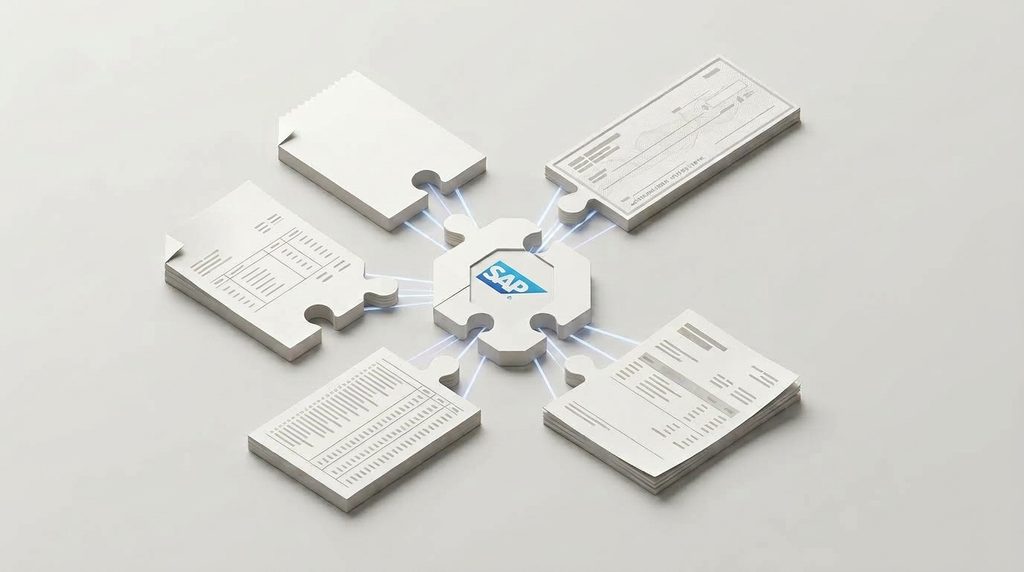
In short, we can turn historical Finance decisions into a source of matching intelligence. And that creates a very specific opportunity: increase the share of payments that can move through AR without manual investigation.
The more payments the model can confidently match, the less time analysts spend researching references, comparing open items, and calculating allocations. That has a direct operational impact.
AR can spend less time resolving repetitive exceptions and more time handling the payments that genuinely require judgment. At higher transaction volumes, even a modest increase in automated matching can translate into a meaningful reduction in manual clearing work.
The important point is where the ML creates value: it does not simply process the payment faster. It helps determine which open items the payment belongs to, using patterns that standard matching logic may not capture.
Applying the Same Logic to Lockbox Items
Now consider the same type of payment arriving through a U.S. lockbox.
A bank processes customer payments through the lockbox and sends the resulting information to the company. The organization now has a payment that needs to be associated with the appropriate receivables.
If the available information is sufficient, standard processing can handle the transaction. When it is not, the matching process becomes the next point of attention.
Cash application provides Receivables Line-Item Matching for Lockbox, which generates proposals for matching receivables with incoming lockbox files and can support automatic clearing. In fact, SAP identifies this service as specifically relevant to the U.S. market.
Here again, ML operates at the matching layer.
The lockbox file is part of the banking process. Cash Application then applies machine learning to the receivables-matching problem, generating proposals based on learned patterns.
For Finance, the benefit is the ability to process more lockbox items without sending every exception to an accountant for manual investigation.
This distinction matters when evaluating the architecture. Because, again, Cash Application does not replace the bank connection or the broader lockbox process. It adds an ML-based matching capability within that workflow.
Payment Advice Processing: Turning Remittance Information into Usable Data
Let’s return to our $250,000 payment. Our customer may also send a payment advice explaining how the money should be allocated. It could arrive as a PDF containing the customer name, payment amount, and the five invoice numbers.
The information exists, but it is not necessarily available to SAP in a structured format.
This is where Payment Advice Extraction comes into the picture. SAP describes this service as extracting payment information from unstructured payment advices in PDF format and using that information to automate the clearing process.
The ML application here is different from line-item matching.
Instead of predicting which invoices should be matched, the service first extracts relevant information from the document. That information can then support the subsequent matching and clearing workflow.
For our example, the process could look like this:
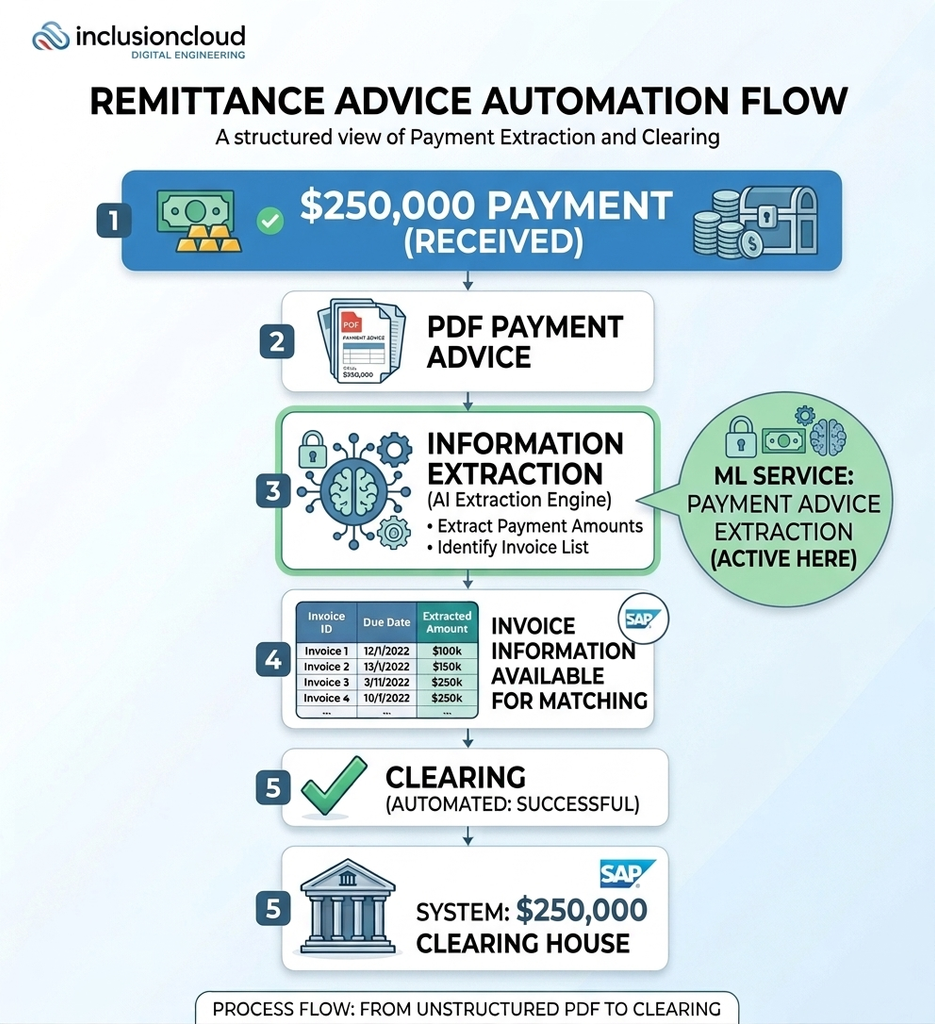
The business benefit is the reduction of manual document handling. Finance does not need to treat every remittance document as a separate research task before the information can enter the payment application process.
It also illustrates an important point about cash application: its ML services address different parts of the payment workflow. Payment Advice Extraction and Receivables Line-Item Matching solve related problems, but they perform different tasks.
Cash Visibility & Order-to-Cash: Towards a clearer financial picture
The $250,000 payment also sits within a much larger Order-to-Cash process.
The customer has received the products, invoices have been issued, and the payment has now arrived. The final step is making sure the payment is reflected correctly against the customer’s outstanding receivables.
This is where payment application becomes relevant to the broader O2C workflow.
When a payment remains unapplied, the customer account can continue to show invoices as open even though the money has already reached the company. Once the payment is correctly matched and cleared, Finance has a more accurate view of which receivables have been settled.
SAP Cash Application contributes to this stage through its matching services. SAP describes Receivables Line-Item Matching as providing proposals for incoming bank statement items and supporting automatic clearing.
The ML component therefore sits inside the payment-matching stage of O2C.
The broader benefits can extend to collections and cash visibility because downstream Finance teams can work from more accurate receivables information. However, those processes involve additional SAP capabilities and business workflows beyond the ML services themselves.
That distinction is useful when evaluating the business case. Cash Application can improve a critical point in the O2C cycle, while the resulting data can support activities further downstream.
For our $250,000 payment, the journey is now:
1. The bank sends the lockbox information to SAP
The payment enters SAP with the customer and remittance information available from the bank.
2. Standard matching tries to resolve the payment
If the available references are sufficient, the payment can be processed normally. If they are incomplete, the item requires further matching.
3. Cash Application applies ML to the matching stage.
Receivables Line-Item Matching for Lockbox generates proposals for matching lockbox items with open receivables and can support automatic clearing. SAP identifies this service as specifically relevant to the U.S. market.
Here again, ML operates at the matching layer. The model can use historical matching and clearing relationships to evaluate the $250,000 payment against the customer’s open invoices and propose the five invoices that best correspond to it.
4. Finance reviews or clears the proposal
If the proposal meets the configured conditions, the payment can move toward automatic clearing. Otherwise, Finance can review the suggested match instead of investigating the payment from scratch.
Accounts Payable: Applying ML to the other side of the ledger
The same matching challenge appears on the payables side, although the transaction flow is different. Just imagine that our fictional company has a supplier-initiated payment that needs to be matched against open supplier invoices.
SAP Cash Application includes Payables Line-Item Matching, which proposes matches between supplier invoices and supplier-initiated payments and can support automatic clearing based on configured thresholds. Once again, ML operates at the matching stage.
The service analyzes the available information and proposes which open payables correspond to the payment. Finance can then use the configured controls to determine whether the proposal can proceed automatically or requires review.
In this case, the business benefit is similar to AR: less repetitive investigation and more consistent processing of transactions that would otherwise require manual matching. However, it is important to keep the scope clear.
Payables Line-Item Matching addresses payment-to-open-item matching. It should not be confused with supplier invoice capture, purchase order matching, invoice verification, or the broader procure-to-pay process.
The Results of SAP Cash Application Use Case
So, what can this look like in practice? SAP provides a useful reference point with its own Cash Application use case. In fact, the company reports a 71% reduction in Accounts Receivable matching effort, along with a 0.5% reduction in Days Sales Outstanding (DSO).
The first number connects directly to the workflow we have been following. If ML can generate reliable proposals for incoming payments and open receivables, fewer transactions need to be researched and matched manually.
The impact is therefore measured in Finance effort: less time spent investigating payments, identifying accounts, and determining which items should be cleared.
However, DSO (Days Sales Outstanding) result shows how that operational improvement can extend into the broader Order-to-Cash process. Faster matching means payments can be applied to the right receivables sooner, giving Finance a more current view of what has actually been collected and what remains outstanding.
These figures should be read as SAP-reported results from its use case, rather than as a guaranteed outcome for every implementation.
The actual impact will depend on payment volumes, existing automation, the quality of historical matching data, and how much manual work remains in the current process. That is also why the value of Cash Application is worth looking at beyond the individual matching transaction.
The IT Distinction That Matters
Across this mapping of SAP Cash Application use cases, one architectural principle remains consistent: The module complements existing clearing logic with ML-based proposals.
In fact, SAP S/4HANA already provides standard capabilities for posting incoming payments, clearing open items, and reprocessing bank statement items. Cash Application adds ML services that can generate proposals for transactions that require more sophisticated matching.
That creates a practical model for Finance and IT, which can be summarized in this three steps:
- Standard rules handle the transactions they can resolve.
- When a payment requires more analysis, ML generates a matching proposal based on the available data and learned patterns.
- Configured confidence thresholds and business controls then determine whether that proposal can support automatic clearing or should be reviewed by Finance.
The business case therefore starts with the current process.
- What percentage of payments is already processed through standard rules? To establish how much of the existing workflow is already automated.
- Which exceptions generate the most manual work? To identify where ML could have the greatest operational impact.
- Is there enough useful historical matching data? Historical clearing decisions provide important context for ML services and should be assessed as part of the implementation.
- Which decisions should remain under human review? Finance can define the control boundaries for automation based on risk, confidence, and the nature of the transaction.
Together, these questions provide a practical starting point for the SAP Cash Application use cases we have mapped throughout this article. They connect the technology to the existing payment workflow, the exceptions creating manual work, the data available to support ML, and the level of control Finance wants to maintain.
And that is probably the most useful way to approach cash application: start with the payments already moving through Finance, understand where the process slows down, and then determine where ML-based matching can actually improve it.
If you are evaluating SAP Cash Application, we’d be glad to learn more about your current payment workflow and help assess where it could add value.
Book a discovery call and tell us your business case. We can help you look at the matching process, the role of ML, the level of automation that makes sense, and the potential impact on Finance operations.